Can We Imagine Life Without Antibiotics?
We rarely think about it, but antibiotics are an almost daily presence in our lives. Many things we take for granted today—treating wounds, curing a sore throat, repairing teeth, or undergoing surgery—would be unimaginable without this miraculous medicine. But how did it come into existence? How did one vacation, poor hygiene in a laboratory, and a middle-aged scientist lay the foundations of modern medicine and pharmacy?
The Discovery of Penicillin
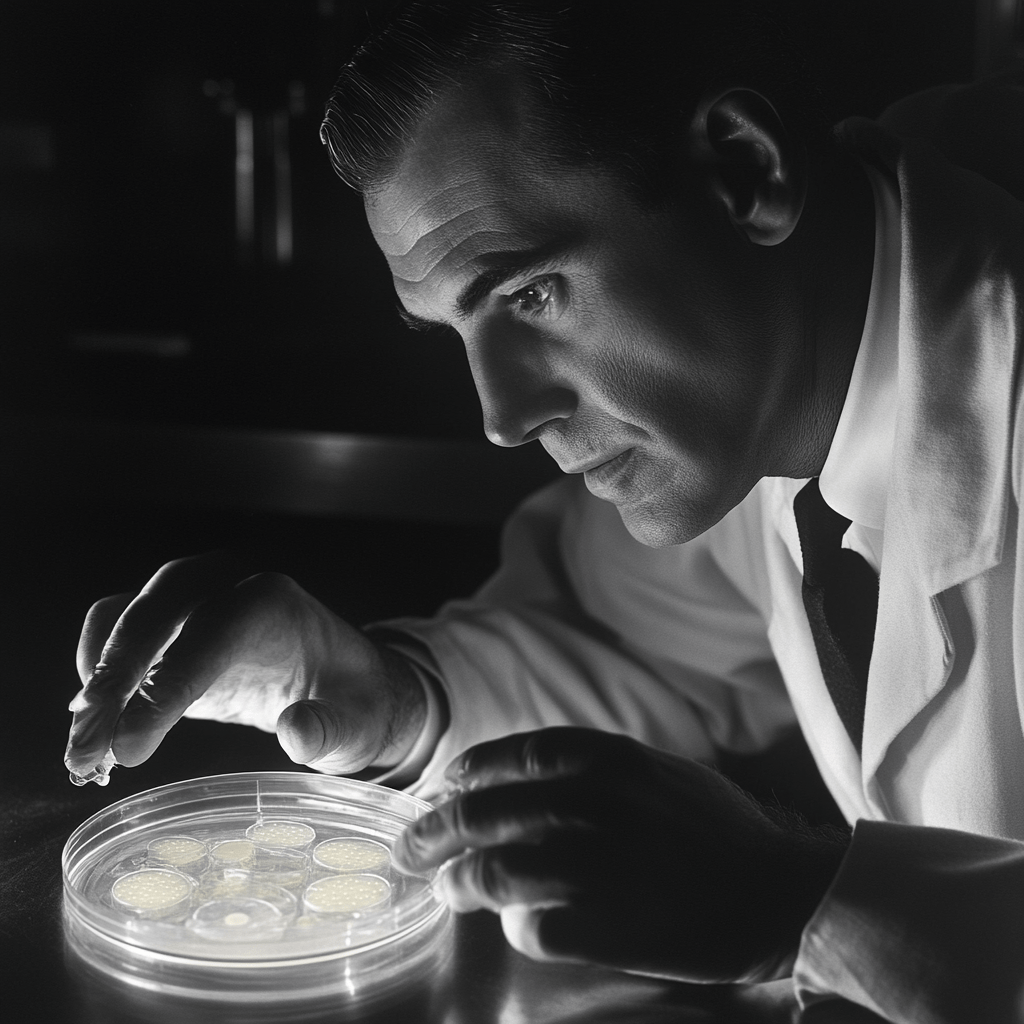
The story begins at St. Mary’s Hospital in London. Scottish microbiologist Dr. Alexander Fleming returned from his vacation to find mold growing in a petri dish during his absence. Luckily, he didn’t do what most of us would—clean the dish. Instead, something caught his attention: in the petri dish where he had been studying colonies of Staphylococcus aureus, mold had developed in the center and completely destroyed the bacteria. The bacteria survived only around the edges of the dish.
Fleming didn’t immediately shout “Eureka!” and run naked through the streets of London (like Archimedes in the streets of Syracuse centuries earlier), but his discovery was no less revolutionary. He named the substance Penicillium notatum.
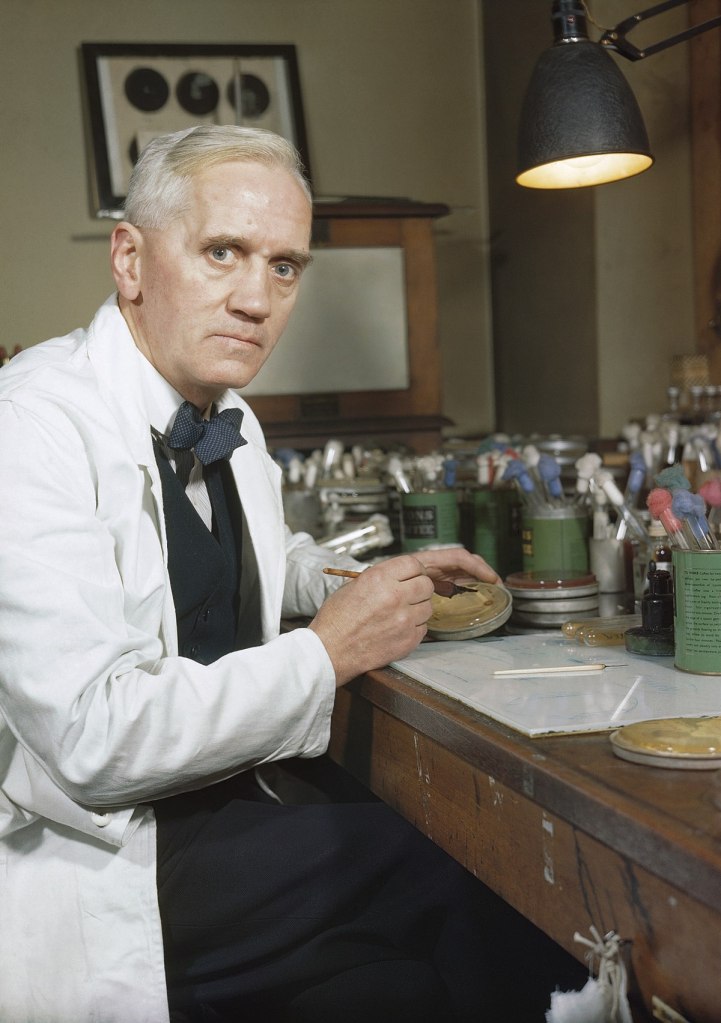
Alexader Fleming in his laboratory
Skepticism and Early Challenges
Initially, the discovery wasn’t taken seriously. Some scientists believed it was impossible to produce this substance for treatment. Fleming’s discovery was considered a serendipitous, interesting tale suitable for London pubs or holiday stories for grandchildren.
Had there been no urgent need for it, it might have remained a story told by old Fleming, similar to Uncle Albert’s war tales in Only Fools and Horses. The problem was isolating penicillin from the mass of mold to create a usable pharmaceutical form. It took about ten years for things to progress.
Further Development and Mass Production
Around 1937, a team of scientists at Oxford University began further developing Fleming’s discovery. Their goal was to isolate penicillin to enable mass production and use in treating various infections.
The times desperately called for such a medicine. During the Industrial Revolution, the rise of factories, automobiles, air pollution, and machinery led to injuries, infections, and respiratory diseases. Open wounds often became infected, resulting in death or, at best, limb amputation. A medicine that could kill bacteria was as vital as rain in a desert.
World War I (1914–1918) further underscored this need. Unaware of the horrors Europe and the world would face in just a few years, several scientists worked tirelessly to isolate penicillin.
Challenges in Isolating Penicillin
Isolating the active substance from mold was far more challenging than it seemed. Massive amounts of mold were required to extract even a grain-sized amount of penicillin. By 1940, the first breakthroughs in isolation and mass production began to emerge.
The impending war and the involvement of American pharmaceutical companies enabled mass production and widespread use, particularly in military applications. This marked the beginning of a journey that would save countless lives, enable the development of new branches of medicine like surgery, and lead to the creation of new antibiotics. But it also brought a significant challenge.
Antibiotic Resistance
Even in the early days of penicillin use, Fleming warned about the possibility of bacterial resistance.
What Is Antibiotic Resistance?
The simplest example is beta-lactamase, an enzyme that breaks the beta-lactam ring of antibiotics. Let’s take amoxicillin as an example, one of the most commonly used antibiotics for treating respiratory infections. Amoxicillin is a direct descendant of penicillin and has been an extremely effective means of fighting sore throats, for instance, for decades. Amoxicillin contains a ring in its structure, called the beta-lactam ring, which is essential for its function.
After years of heavy use and significant losses in the fight against amoxicillin, bacteria become “smarter” and adapt their genetic material by creating a gene for producing the enzyme beta-lactamase. The enzyme gets its name because, upon contact with amoxicillin, it breaks this ring, rendering the antibiotic inactive.
When this occurs, we say that the bacteria are resistant to antibiotics. In this case, there are two options: the development of a new antibiotic or the modification of the existing molecule. In this particular case, adding clavulanic acid partially solves the problem because clavulanic acid inhibits the bacterial enzyme beta-lactamase, preventing it from breaking the ring in amoxicillin’s structure.
This restores the antibiotic’s activity, and when bacteria respond to the antibiotic, we label it as sensitive.
When you see a prescription for Amoxicillin-Clavulanic Acid (e.g., Amoxiclav 875/125 mg), you now know the reason.
Modern Antibiotics
The penicillin Fleming discovered is no longer used today. Over time, more potent antibiotics, both semi-synthetic and synthetic, have been developed to treat a wide range of infections. These antibiotics come in various forms—drops, ointments, tablets, capsules, syrups, or injections—and have entirely different structures and mechanisms of action.
However, they are not immune to resistance. Many antibiotics are no longer effective against numerous infections or are no longer used for their original purposes.
The First Step to Combat Resistance
The first step in combating resistance is the responsible use and prescription of antibiotics. Antibiotics do not treat viral infections like the flu, where they are often misused.
Some new antibiotics are produced as intravenous infusions or injections and are “jealously” guarded for hospital use in life-saving situations. Responsible usage ensures these medicines remain effective for as long as possible.

 The Hungry Pharmacist
Leave a reply to The Most Bizarre Medicines Throughout History – The Hungry Pharmacist Cancel reply