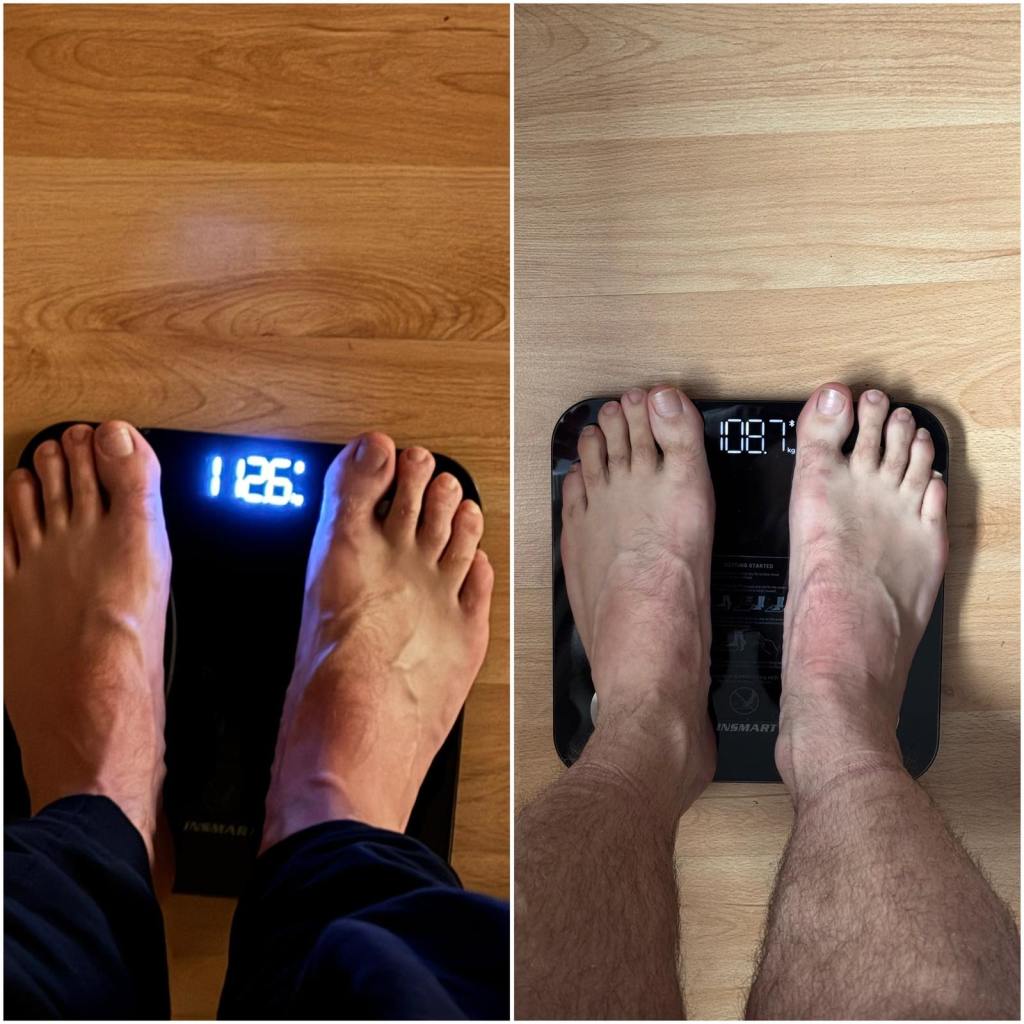
Since during November and December—partly due to cold weather and short days, and partly because food is more readily available in the holiday season—I ate more and trained less. No wonder that I was unpleasantly surprised when I stepped on the scale after New Year’s: 112.6 kg (around 248 lbs).
Although I am 190 cm tall (around 6’2 feet) and have a fair amount of muscle, my stomach was larger than usual (even though this wasn’t my highest body weight). I felt heavy, sluggish, and low on energy.
That was my wake-up call to take action because if I continued down this path, I wouldn’t be able to walk normally anymore. Just before this, I had started incorporating more intense cardio and running, aiming to participate in 5K and 10K races in spring. However, with my current body weight, that wasn’t realistic.
Fortunately, this wasn’t my first time needing to lose weight, so I already had a solid plan for shedding a few kilos.
My Struggle with Food
My story is closely tied to food—I have a weak will when it comes to cravings. When I go through a “weak” period, meaning when I can’t resist food temptations, I tend to overeat, consuming between 3,000 and 4,000 calories daily.
When I notice I’ve crossed the limit, I impose restrictions again, and the cycle repeats. While writing this, I am fully aware that this might happen again, because my brain is constantly looking for distractions—not to starve, but to store as much energy as possible, especially in the winter.
My Plan Had Several Key Rules:
- Eliminate bread and sweets for at least the first two weeks
- Train at least 4 times per week
- Walk at least 6,000 steps daily
- Keep daily calorie intake below 2,000 kcal
- Get at least 7 hours of sleep per night
Cutting Out Carbs
This is usually my first step when I want to lose weight. I know many will argue that you can still eat sugar and lose weight as long as you maintain a calorie deficit, and I completely agree. I even wrote about this in “The Biggest Myths About Healthy Eating.”
However, to kickstart my weight loss, I always choose to cut excess carbs for a few reasons:
- Quick Water Loss: In the first few days, the body releases water weight that was stored with carbohydrates. Seeing the scale go down provides extra motivation.
- Sweets Are a No-Go: There is no weight loss without cutting out sweets. Why? Because they are extremely calorie-dense. A 100g chocolate bar has around 500 kcal, which is a huge chunk of your daily limit.
- Bread Leads to Overeating: When I eat bread, I snack more, and instead of one slice, I end up eating 7-8 slices a day.
Instead, I focused on whole foods—eating plenty of broccoli, salad, chicken, yogurt, blueberries, and apples. I also ensured I consumed enough protein to stay full, maintain muscle mass, and train effectively.
Training at Least 4 Times a Week
I aimed to train at least four times weekly while allowing myself one rest day. My focus was on staying active, improving endurance, and maintaining muscle mass.
Each session included:
- Weight training (push, pull, legs split)
- Cardio (jogging, incline walking, cycling)
For example, if I had a leg day, I wouldn’t run 5K afterward but would walk lightly or skip cardio altogether. My weekends usually included heavyweight training (like push day: chest, shoulders, triceps), followed by a Zone 2 endurance session. The next morning, I’d run 5K.
Walking at Least 6,000 Steps a Day
Movement is key, so I made sure to hit this goal daily. It wasn’t too difficult since my job as a pharmacist requires a lot of standing and walking.
My strategy for sedentary workers (office or home office):
- Walk before work to get steps in early
- Take short walks after meals to control blood sugar
Keeping Calories Below 2,300 kcal
This was the most important factor in the entire process.
Here’s how I calculated my daily needs:
- Basal Metabolism (BM): BM=1x90x24=2160kcal (This is the amount I can eat without gaining weight if I don’t move at all.)
- Active Metabolism (AM): AM=2160×1.5=3240kcal (Since I’m active, my body burns around 3,240 kcal daily.)
Why Did I Eat Only 2,300 kcal Then?
- My body functions well at that intake.
- People underestimate how much they eat—so I left some margin for error.
Sleeping at Least 7 Hours a Night
When I was younger, I thought sleep was a waste of time. However, after reading and researching, I now aim for at least 7 hours every night.
My schedule:
- In bed by 22:30
- Wake up between 5:30-6:00
This gave me time to train, walk, or write in the morning. Also, sleeping early reduces late-night cravings.
Results
By February 5, 2025, my weight was 108.7 kg (around 239 lbs)—a loss of 3.9 kg (almost 8 lbs).
I was too lazy to measure waist, chest, or biceps, so I don’t know exactly how much fat vs. muscle I lost, but I was happy because I met my initial goal.
Did I Face Challenges?
Absolutely.
- After losing almost 2 kg in the first week, I plateaued at 110 kg and even went back up to 111 kg at one point. But I knew this was a normal phase.
- I had cravings for sweets and pastries multiple times.
- After 10 days, we had guests over for a dinner, and I ate a big meal and drank few bottles of beer. Another time, I was out with friends, and we had fries and beer.
- The biggest challenge: In the end, I caught a cold that turned into the flu, so I haven’t trained in a week. Walking tires me out, but my appetite hasn’t decreased, making it hard to stay disciplined.
Conclusion
I didn’t follow a super strict diet. Instead, I aimed for a sustainable method—eating less, focusing on whole foods, training regularly, and sleeping well.
When I knew I’d eat extra calories, I compensated by eating less before or after.
The Key Is Consistency & Self-Control.
The goal:
To reach 100 kg (220 lbs) by summer. 🚀
Read also: The Food Pyramid (Part 1)

 The Hungry Pharmacist
Leave a comment